
The ChessBoard
A chessboard and the leadership lesson I'm still learning thirty years later

The Kingfisher Study | Sunday Series Objects That Tell a Story
On Sunday’s I’m writing the stories behind the objects, photo’s, books, and artifacts in my Kingfisher Study - telling the backstories that surround me everyday and which remind me of the overlapping commitments that give my life a thicker identity, belonging, and purpose.
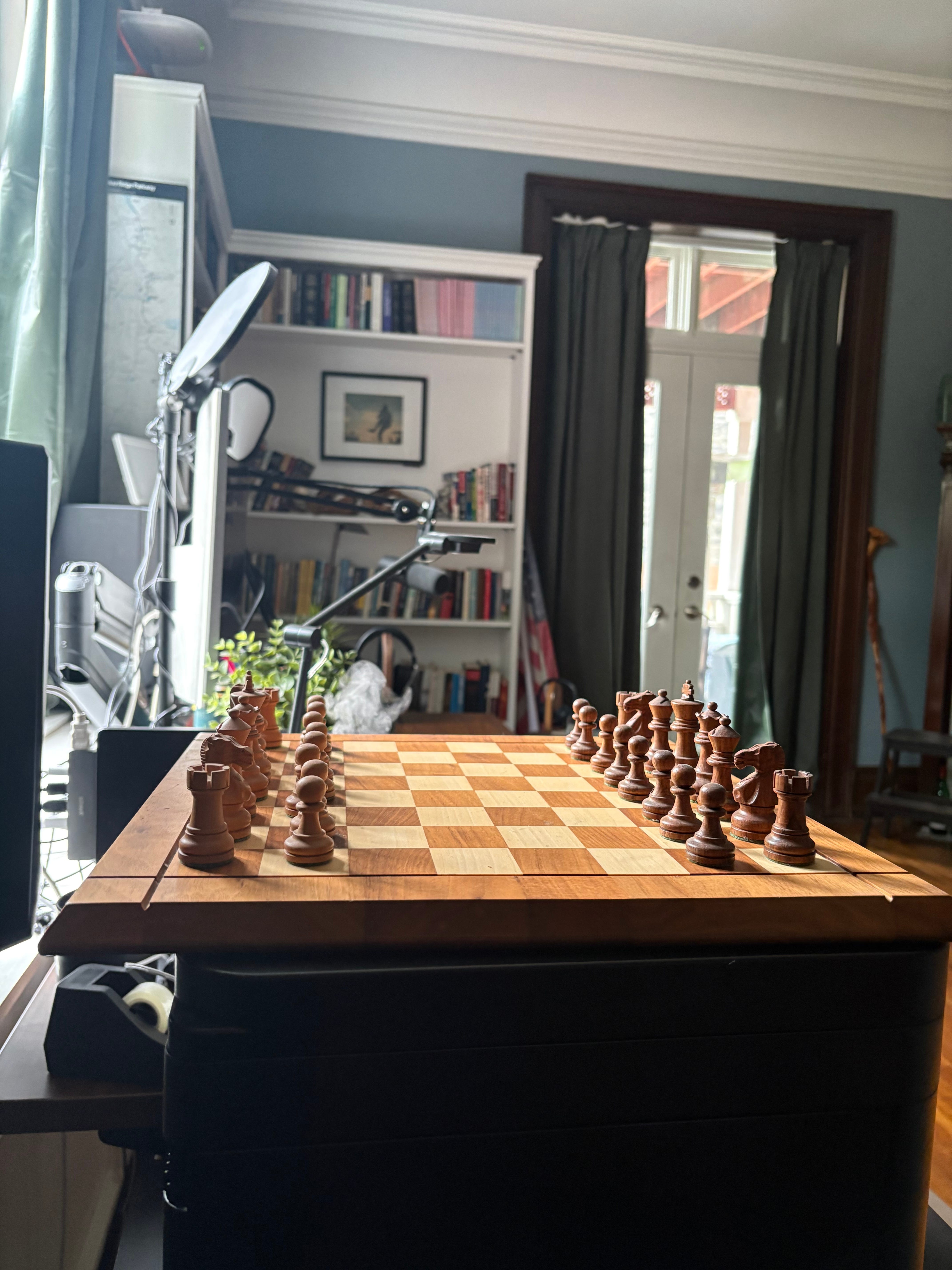
There is a chessboard in my study.
It sits on the printer near the window, next to my desk, not quite a decoration and not quite a game waiting to be played. It is something closer to a message in wood and stone — a thing I pass by every day that refuses to let me forget something essential.
I love chess. I didn’t grow up playing the game of Kings. That’s worth saying at the outset, because the people who grow up playing chess are a lot more clever than I am. Yet, I share a quality those who grew up playing chess as kids possess -they tend to have a certain look about them — quiet, patient, deeply comfortable with silence, with a tacit ability to see the whole board, strategies, ideas, moves in one’s imagination - the engine-block of rationality.
I began to learn chess after I got married.
Kristen’s father, Peter, and I started playing, not long after we got married. I’m still not entirely sure how it happened. There was a big board that was its own table and we would sit and play? Why? One theory — the one I prefer — is that we both loved the same girl and needed to find a civilized way to compete. That’s probably not the whole truth, but it’s the truth I’ve decided to keep. What I know for certain is that somewhere in those early years of marriage, two men who shared a love - one a daughter and one a wife - sat down at this chess table and began the ancient ceremony of moving pieces across squares. I loved those games with Peter - and grateful he was a gracious winner.
You see…I got destroyed. Repeatedly. Enthusiastically. Without mercy.
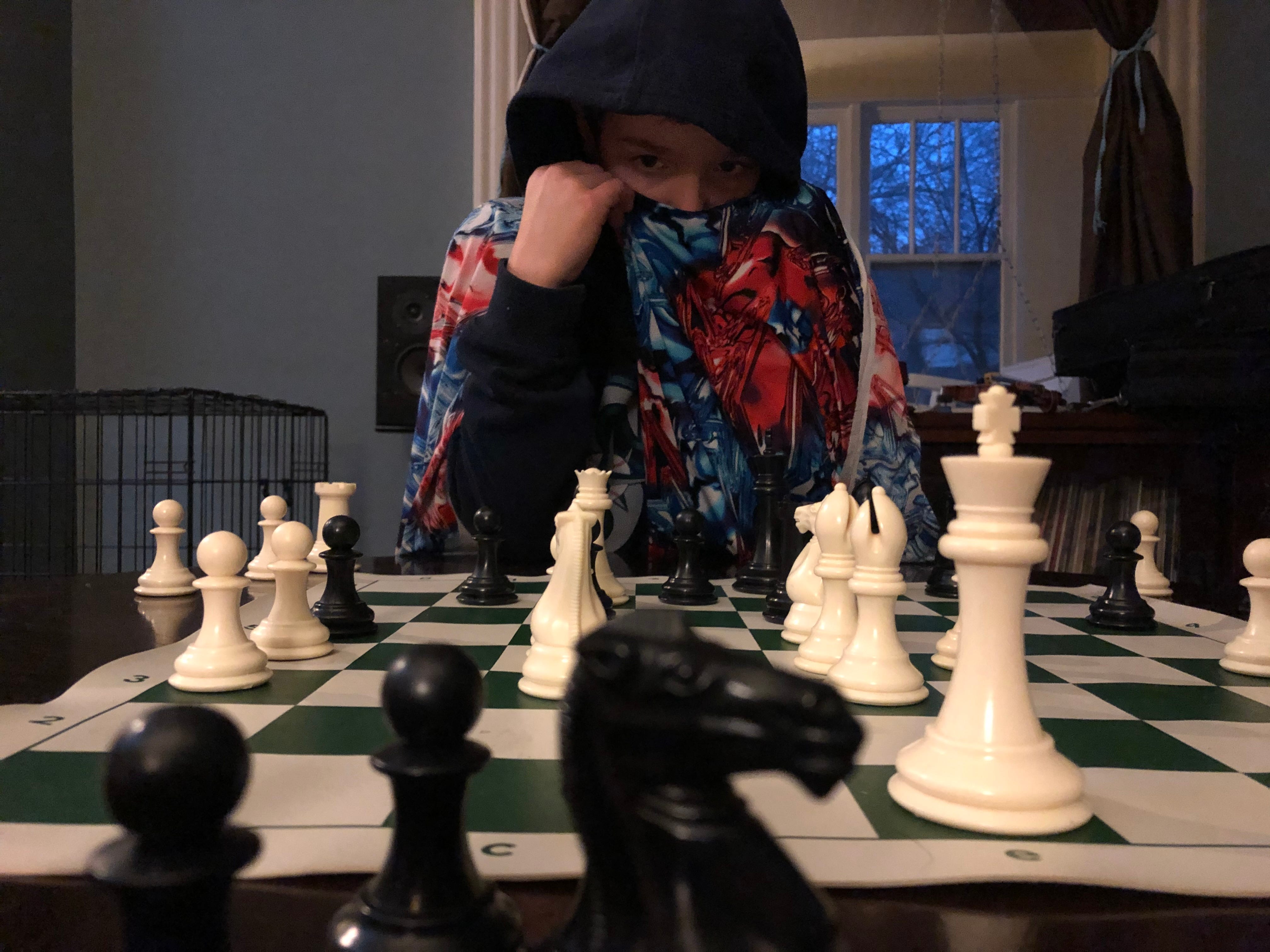
My problem was a rookie’s focus, which is to say it was a character problem disguised as a strategy problem. I would get fixated on one piece. The knight, maybe, or the bishop I’d managed to position just so. I’d build an entire plan around that one piece, follow it A to B to C, and feel quite clever about myself right up until the moment my Peter moved something I hadn’t looked at and the whole architecture collapsed. I was playing chess like a soloist — convinced that if I could just get my piece into the right position, victory would follow.
It took playing against myself to start seeing differently.
I began going through master games — Fischer, Kasparov, the old Soviet school of play — setting up the positions, moving the pieces for both sides, flipping the board around and stepping into the other perspective. And slowly, like a language you learn late in life, the grammar of the game began to take shape. Chess, played well, is not about one piece acting like hero. It is about a community working together - an imagination that thinks in combinations. It is about pawns and bishops and rooks and knights working in concert, each one making the other more dangerous, so that the threat is never isolated in a single place and the opponent never knows quite where the real pressure is coming from.
The moment I understood that, something shifted in me that had nothing to do with chess.
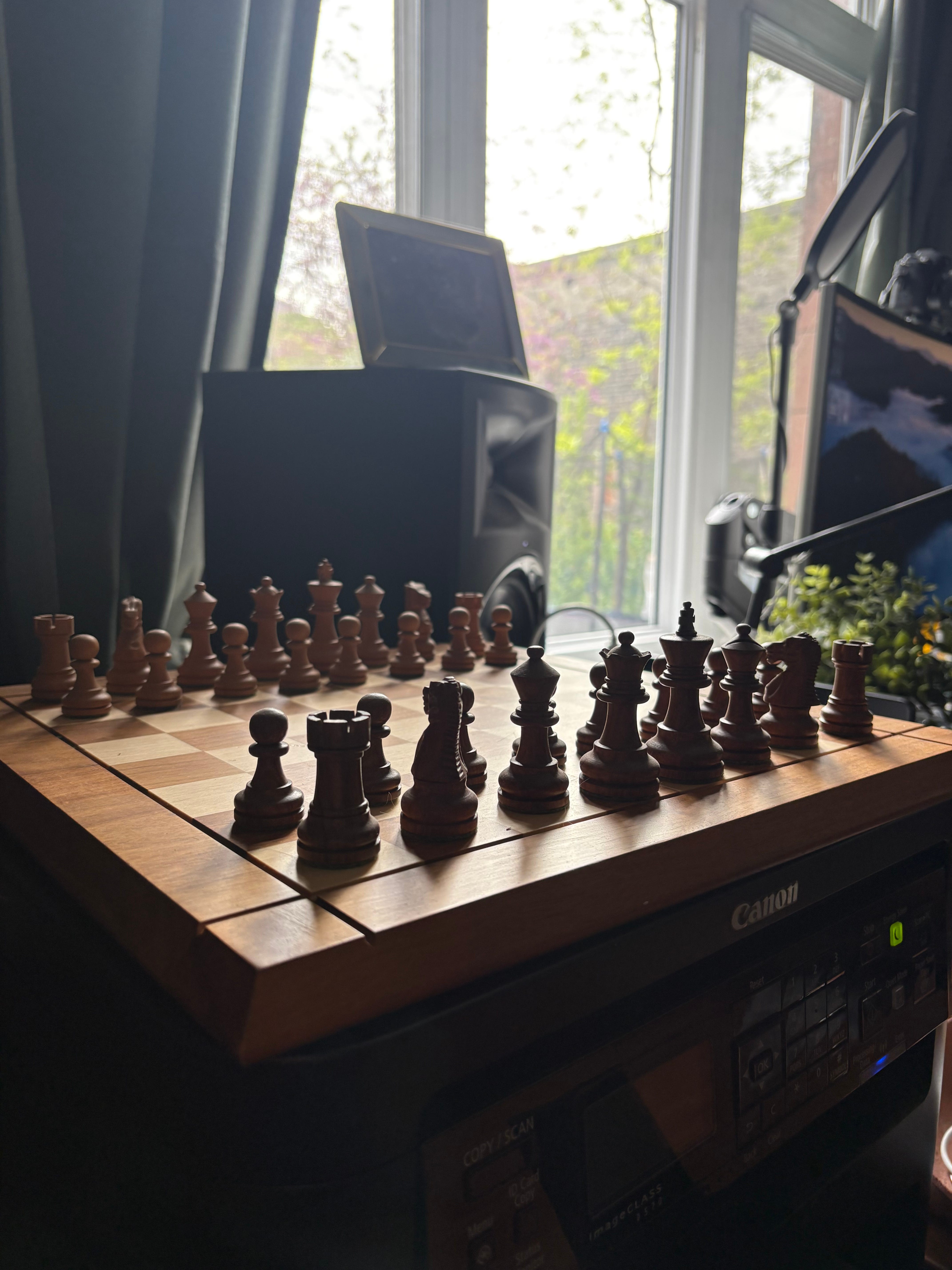
This is why the board stays in my study. Not as nostalgia. Not as decor. As a daily reminder of the thing I most consistently fail to remember: you cannot do significant things alone. Not the things worth doing. Not the things that last. If you want to make an impact, you have to work with the other pieces on the board, and you also have to be willing to sacrifice.
Leadership, in my experience, is mostly the work of fighting this particular temptation — the temptation to believe that if you are capable enough, clear-sighted enough, driven enough, you can carry the thing yourself. It is a seductive lie. It flatters exactly the parts of us that most need to be unsettled. And the institutions and communities and families that suffer most are the ones led by people who never learned to play in combinations — never learned to trust the pawn, to free the bishop, to let the rook do the rook’s work.
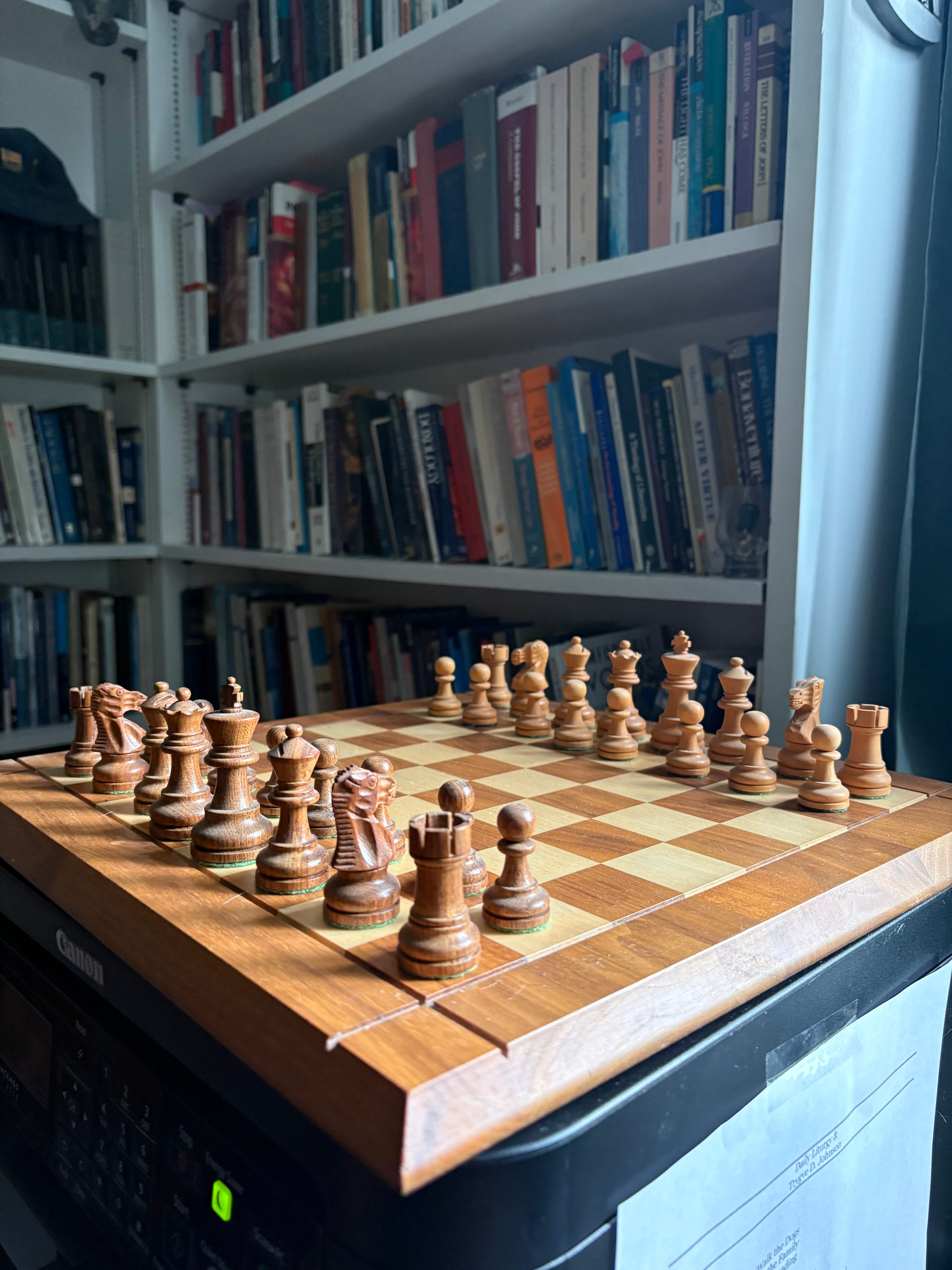
There is a line I’ve heard attributed to various people, and the attribution doesn’t really matter: You can accomplish anything if you don’t care who gets the credit. I have found this to be, in my better moments, genuinely true. And in my worse moments, genuinely unbearable. The ego has opinions about the credit. The ego would like its name on the thing. Chess, at its best, mocks that impulse — because the queen who wins the game did not do it alone, and any queen who tried would have been isolated and taken early.
The board in my study is a question I’ve agreed to live with. Who are the other pieces? Whose gifts am I refusing to deploy because I haven’t been paying attention, because I’ve been too fixed on my own position to see what’s available? What endgame am I working toward, and am I playing it with the imagination and improvisation that a real game requires — or am I running the same linear plan I always run, surprised when it fails the same way it always fails?
Chess also taught me something about patience and about time. The opening, the middle game, the endgame — they are different territories, governed by different principles. What is wise in the opening is often suicidal in the endgame. Leadership is like this. Parenting is like this. Ministry is like this. There are seasons for building position and seasons for pressing the advantage and seasons for the long, patient grind when no decisive move is available and the only faithful thing is to hold the line. The person who plays every phase of the game the same way is the person who loses most often.
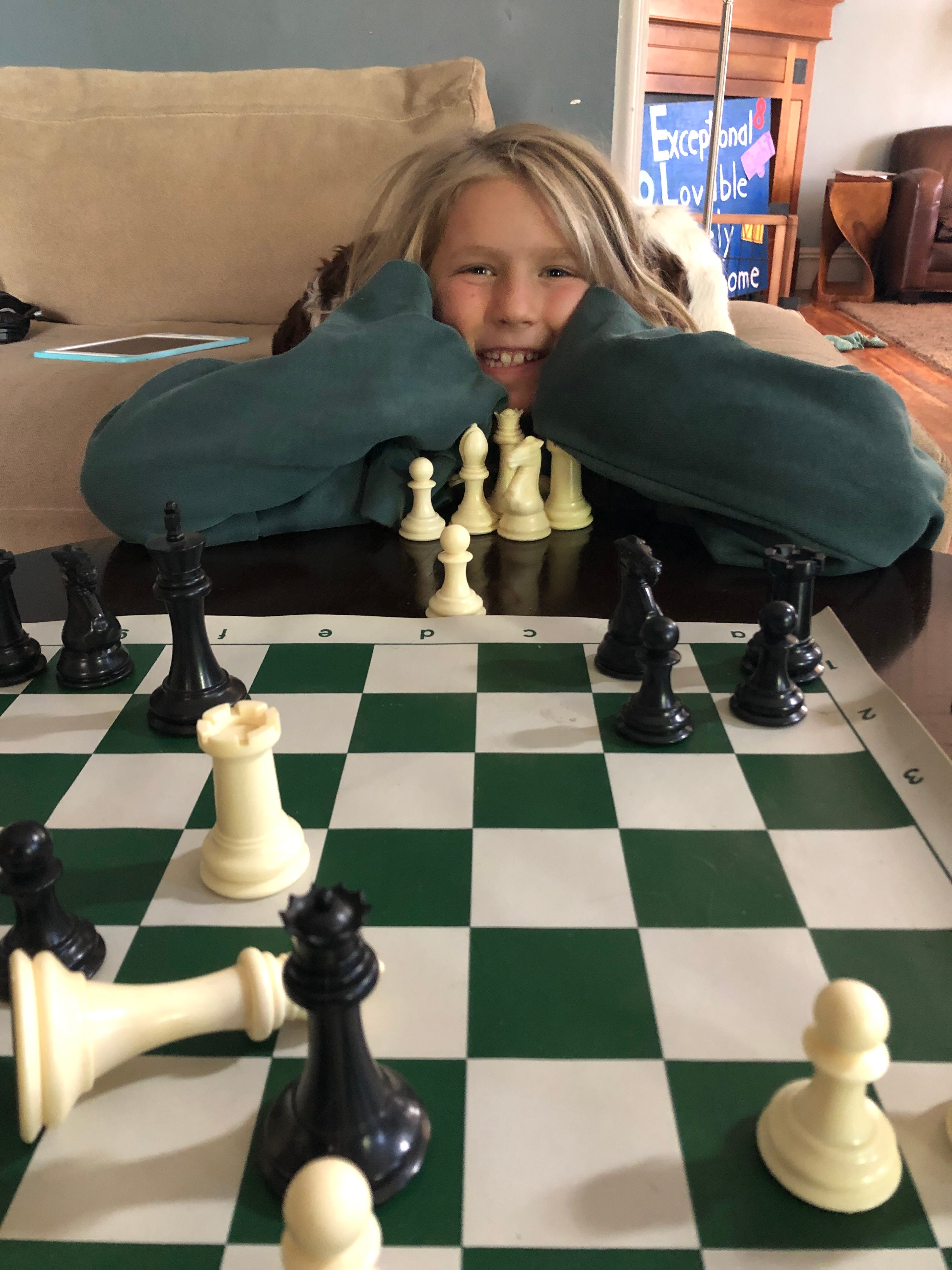
I am not a great chess player. I want to be clear about that. I am average at best. I lose regularly and often. I have taught me kids - and it’s not uncommon for them to beat me. My father-in-law still wins more than I do, and there is probably some justice in that fact. But I understand the game now in a way I didn’t when I first sat down across from him — and what I understan
d is that the game is always, at its root, about a community of pieces in service of a common purpose. It demands strategy, requires an imagination that embraces improvisation, and asks yourself to trust a tacit instinct.
Which is, if I’m honest, what I believe the Christian life is supposed to be. Not a solo act. Not the heroic individual cutting through the world by the force of their own virtue and intelligence and will. But a body — many parts, different gifts, all of them necessary, none of them sufficient alone. Paul said it better than I will. But the chessboard in my study says it in a language I see every day.
So here’s the question I’ll leave with you: Look at the board you’re playing. Whatever your work is, your family, your calling, your community — are you playing it like a solo hero or like a conductor? Who are the pieces you haven’t trusted enough to move? And is there someone in your life who has been waiting for you to finally look up from your own square and see what they can do?
Don’t answer too quickly. Sit with it.
The patience is the point.
Trygve Johnson
Subscribe to The Kingfisher Study
Faithful presence. Thoughtful leadership. Deep formation.
Please share with someone